
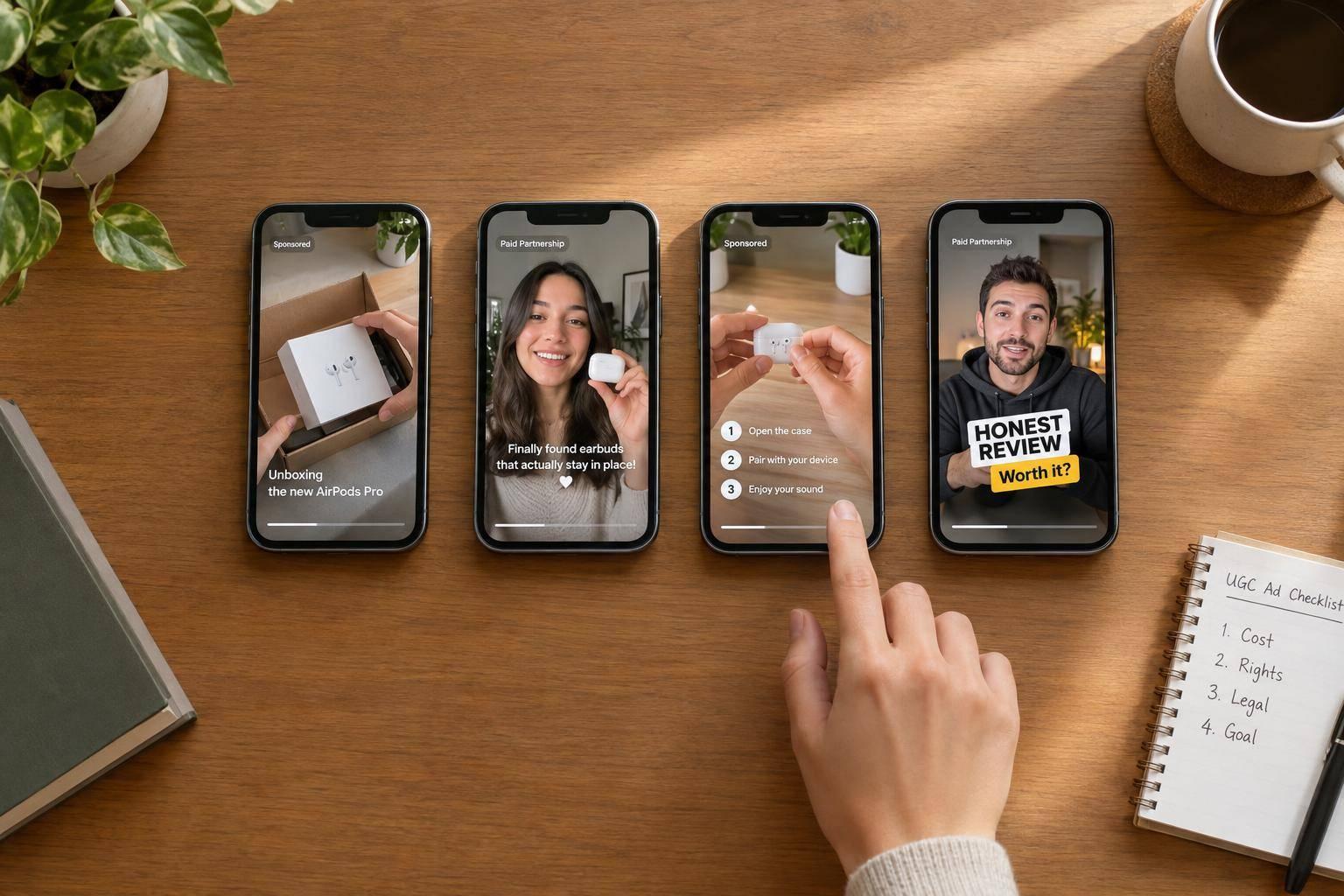
UGC ads are paid ads built from videos or photos made by real people not associated with the brand's own team. They look like organic posts in the feed, so a viewer perceives them as a recommendation before they realize it’a an ad.
Looking like a normal post is important because people trust other people more than they trust ads. In Nielsen's 2021 Trust in Advertising study, 88% of people said they trust recommendations from people they know more than any other channel. A UGC ad is built to look and sound like that kind of recommendation, even though it is paid.
The term also covers more than most people expect. Customer reviews, videos from hired creators, paid influencer posts and AI-generated clips can all be called UGC ads, and each of those 4 types costs a different amount, follows different legal rules and gets different results.
By the end of this guide you will know how to tell the 4 types apart, what each one costs, which type fits your goals, and how to get your first one running.
Key Takeaways
- UGC ads are paid social ads made from content that real people filmed, and they work because users treat them as recommendations rather than as advertising.
- There are 4 types of UGC ads: customer content, paid creator content, influencer ads and AI UGC-style ads. Each one differs in cost, legal rules and results.
- Paid creator content typically costs $150 to $300 per video and runs from the brand's own ad account, so the creator's follower count has no effect on reach.
- A strong UGC ad shows the product early, names one problem in the viewer's own words and ends with one clear action. TikTok's Creative Codes guidance says 90% of ad recall happens within the first 6 seconds.
- In TikTok's own data from 2020 to 2021, ads made with a creator got 83% higher engagement than ads that were not made for TikTok.
What Are UGC Ads?
A UGC ad is any paid ad whose content was made by a real person rather than a brand's creative team. It is usually a short phone video running on TikTok, Instagram Reels, Facebook or YouTube Shorts, and 3 traits separate it from every other kind of ad:
- A real person makes it. A customer or a creator films it, usually on a phone, instead of a studio crew.
- It looks like an organic post. The lighting, the framing and the way the person talks all match the unpaid videos around it.
- It runs as a paid placement. A brand pays to show it to an audience. A post someone shares on their own account, with no brand paying to show it, is not a UGC ad.
Any video with all 3 counts as a UGC ad, no matter who filmed it. Brands use UGC ads because they do 6 things better than studio ads.
6 Benefits of UGC Ads for Brands
UGC ads give brands 6 benefits over studio ads: more trust, more attention, the product shown in real use, a lower cost per video, room to test and fast replacement.
- More trust. A person saying they use a product sounds like a recommendation, while a logo saying the same thing sounds like a claim.
- More attention. A video that looks like the posts around it gets watched before the viewer decides it is an ad. In TikTok's analysis of around 220 brand lift studies from 2020 and 2021, ads made with a creator got 91% higher 6 second view rates and 83% higher engagement than ads not made for TikTok.
- The product in real use. A creator applying a serum shows the product working in a real home. A product photo can only show what it looks like.
- A lower cost per video. There is no crew, studio or set to pay for, since the creator films on a phone in their own space.
- Room to test. Most ads will not work, and a low cost per video means you can afford to test 5 or 10 versions to find the one that does.
- Fast replacement. Every ad stops working as well once the same people have seen it too often. A new creator video can be ready within days, so you can replace an ad before its results drop.
No single type of UGC ad gives you all 6. Customer content earns the most trust, paid creator content is the easiest to test in volume, and influencer ads reach the most new people.
What Are the 4 Types of UGC Ads?
The 4 types of UGC ads are customer content, paid creator content, influencer ads and AI UGC-style ads. Each one changes who makes the video, whose account it runs from and who owns it.
| Type | Who makes it | Runs from | Who owns the rights |
|---|---|---|---|
| Customer content | Your customers | Your ad account | The customer, until they agree in writing |
| Paid creator content | A creator you hire | Your ad account | You, on the terms in the brief |
| Influencer ads | An influencer | The influencer's account | Agreed deal by deal |
| AI UGC-style ads | Software | Your ad account | You, under the tool's terms |
Type 1: Customer Content
Customer content is anything your customers have already posted about your product, such as reviews with photos and unboxing videos. People trust it more than any other type, since the person really is a customer.
- Best for: retargeting people who already know your brand and need proof before they buy.
- What a good one looks like: a customer filming the product at home and saying, in their own words, what problem it solved for them.
- Where it falls short: you get whatever customers chose to film, and each video needs written permission before it can run as an ad.
Type 2: Paid Creator Content
Paid creator content is a video you hire a creator to film, and it runs from your own ad account. The ad reaches the audience you target, not the creator's followers, so you are paying for the video, not for an audience.
- Best for: testing several versions of an ad on new audiences.
- What a good one looks like: a creator who looks like your customer, filming in the room where the product would actually get used.
- Where it falls short: the creator needs time with the product to sound convincing, so it helps to send it early.
Type 3: Influencer Ads
Influencer ads pay for a creator's audience as well as their video, and the post goes out from the influencer's own account.
- Best for: putting your brand in front of an audience your own ad account cannot reach yet.
- What a good one looks like: the influencer using the product in the kind of content their followers already watch, with the payment clearly disclosed.
- Where it falls short: pricing follows audience size, not video quality, so 2 influencers can charge very different amounts for similar work. You also usually cannot test many versions.
Type 4: AI UGC-Style Ads
AI UGC-style ads are videos made by software, with an AI-generated person and voice, built to look like customer or creator content.
- Best for: checking which script or opening line holds attention before you pay creators to film it.
- What a good one looks like: a product demo narrated by an AI presenter, tested against 2 or 3 other opening lines.
- Where it falls short: an AI person has never used your product, so the ad loses the trust that makes UGC work. TikTok also asks you to label AI-generated content.
Once you know the 4 types, the first way to compare them is cost.
How Much Do UGC Ads Cost?
UGC ads cost from $0 to around $800 per video, depending on the type. Customer content is free to produce, paid creator videos typically cost $150 to $300 each, and a TikTok video from a micro influencer usually costs $200 to $800.
| Type | Typical cost | What moves the price |
|---|---|---|
| Customer content | $0 to produce | The time it takes to find posts and get permission |
| Paid creator content | $150 to $300 per video on average, or $50 to $100 from beginner creators | Video length, usage rights, edits and whether you send the product |
| Influencer ads | $150 to $500 per Instagram post, or $200 to $800 per TikTok video, for micro influencers | Audience size and engagement |
| AI UGC-style ads | A monthly software subscription | How many videos you make each month |
Creator rates come from a 2026 compilation of published marketplace prices, which also notes that longer or wider usage rights often add 30% to 50% to the price. Influencer rates come from Influencer Marketing Hub's 2026 rate guide. Both are averages, so they work best as a starting point for your own quotes.
Once you know what each type costs, the next question is what you are legally allowed to run.
Are UGC Ads Legal?
Yes, UGC ads are legal as long as you have permission to use the content and you clearly disclose any payment. The rules differ by type:
- Customer content needs written permission from each person before it runs as an ad. A customer tagging your brand in a public post is not the same as permission to use it in a paid ad. A short message saying where the video will run and for how long is usually enough to ask.
- Paid creator content comes with usage rights agreed in the brief, before the creator films anything. They cover where the video can run, for how long, what edits you can make and whether the creator can work with a competitor. Settling them up front matters, since going back to a creator after a video has started working leaves you less room to negotiate.
- Influencer ads have to be disclosed. The FTC's guidance on endorsements and influencers treats payment and free product as connections that need to be disclosed clearly.
- AI UGC-style ads need an AI label on any platform that asks for one.
This is general guidance, not legal advice.
What to Agree in a Creator's Usage Rights
Settle these 4 points in the brief, since going back to a creator after a video has already started working puts you in a weaker position to negotiate:
- Where the video can run: which platforms, and whether as paid ads, organic posts or both.
- How long: a fixed period such as 6 or 12 months, or with no end date.
- Edits: whether you can cut it, add captions, reframe it or combine it with other footage.
- Exclusivity: whether the creator can film for a competing brand during the same period.
For the skincare brand, the fastest start is sending that permission message to the customers whose reviews include photos or video, and running only the ones that reply yes.
With cost and rights settled, you can pick the type based on what you need the ad to do.
How to Pick the Right Type of UGC Ad
Picking the right type of UGC ad comes down to 3 questions, answered in order.
What Do You Need the Ad to Do?
Most UGC ads are built for one of 3 jobs. They build trust with people who already know you, they reach people who do not, or they test many versions to find the one that works. Customer content suits the first job, influencer ads suit the second, and paid creator content suits the third.
How Many Ads Do You Need Each Month?
If you need 1 or 2 ads a month, customer content or a single influencer can cover it. At 10 or more, paid creator content is the only type that keeps up, since it is the only one you can order in quantity, in the format you choose, on your own timeline.
How Much Control Do You Need?
Control covers the format, the script and the rights. Customer content gives you the least, since you get what customers already filmed. Paid creator content gives you the most, since you set all 3 in the brief before filming starts.
The types also work well together. The skincare brand needs about 10 videos a month to find what sells, so it tests paid creator content on new audiences and saves its best customer reviews for retargeting.
Here’s a table that you can save as a checklist.
| Your goal | Type to use | Why |
|---|---|---|
| Build trust with people who visited your site | Customer content | Real customers carry the most trust |
| Reach an audience that does not know you | Influencer ads | You pay for access to their followers |
| Test many versions to find a winner | Paid creator content | The only type you can order in volume |
| Check a script before paying for filming | AI UGC-style ads | Fast and cheap per version |
| Run ads on TikTok Shop at volume | Paid creator content | TikTok Shop needs many videos in shoppable formats |
Once you have chosen the type, the next decision is what the video should look like.
6 Common UGC Ad Formats With Examples
The 6 most common UGC ad formats are testimonial, problem and solution, unboxing, ranking, day in the life and tutorial. Naming one format in the brief is the easiest way to get videos you can compare against each other. Here is each one with an opening line from the skincare brand:
| Format | Example opening line | Works best for |
|---|---|---|
| Testimonial | "I have used this serum every night for a month, and here is what happened." | Retargeting |
| Problem and solution | "My skin was dry by lunchtime every single day, until I changed one thing." | Cold traffic |
| Unboxing | "This just arrived, and I have wanted to try it for weeks." | New or giftable products |
| Ranking | "I tried 4 moisturizers so you do not have to." | Crowded categories |
| Day in the life | "My whole morning routine before work, start to finish." | Products used every day |
| Tutorial | "How to apply this so it actually lasts all day." | Products that need explaining |
Every example line opens on something the viewer recognizes, not on the brand name. For each format broken down by platform and funnel stage, see How to Scale Ads With UGC.
2 videos in the same format can still perform very differently, so it helps to know what a strong one looks like.
What Makes a High-Quality UGC Ad?
A high-quality UGC ad has a strong hook, one clear problem, a demo that shows the product working and one clear call to action, in that order. The first 6 seconds matter most, since TikTok's Creative Codes guidance says 90% of ad recall happens in that window.
| Part | Timing | Weak version | Strong version |
|---|---|---|---|
| Hook | 0 to 3 seconds | "Hi, I want to tell you about this new serum." | "My skin was dry by lunchtime every single day, until I changed one thing." |
| Problem | 3 to 8 seconds | "Many people struggle with skin hydration." | "I would put moisturizer on at 7, and by noon my face felt tight again." |
| Demo | 8 to 20 seconds | Holding the bottle and reading out the ingredients | Applying it on camera and showing how quickly it absorbs |
| Call to action | Last 3 to 5 seconds | "Check out our website for more products!" | "It is 20% off this week, and the link is right below this video." |
The weak versions all describe the product. The strong ones show the product being used, in words a customer would actually say.
6 Things to Check Before You Run a UGC Ad
Run every video through this list before it goes live:
- The product appears in the first few seconds. TikTok's guidance says showing the product on screen drives a 65% increase in brand affinity.
- The person looks and sounds like your customer. Viewers stop for someone who seems like them, so the closer the age, setting and way of speaking are to your buyers, the better.
- The setting matches where the product gets used. Skincare belongs in a bathroom and a kitchen gadget in a kitchen, since the room tells the viewer who the product is for.
- The video sticks to one message. A video that tries to cover 3 benefits usually makes none of them clear.
- The sound is clear and the captions are on screen. Captions keep the message in front of anyone watching with the sound off.
- It ends with one clear action. TikTok found that adding a CTA card lifted ad recall by 45%.
TikTok does not say when its Creative Codes figures were measured, so they work best as guidance, not benchmarks.
Once you know what a good UGC ad looks like, the brief is easy to write.
How to Get Your First UGC Ad Running
Getting your first UGC ad running takes 5 steps: pick the type, pick one format, write a one-page brief, order 3 to 5 videos and run them at equal budget.
- Pick the type. For a first test on new audiences, paid creator content is usually the right start, since you control the format and can order several videos at once.
- Pick one format for the whole batch. When every video uses the same format, any difference in results comes from the creator and the opening line, not from the shape of the video.
- Write a one-page brief. A good brief names the format, the length, the opening line, what must be shown and the usage rights, and leaves everything else to the creator, since their own words make the video sound real.
- Order 3 to 5 videos from different creators. A single video tells you very little, since there is nothing to compare it against.
- Run them at equal budget for long enough to judge. A practical minimum is 2 to 3 times your target cost per acquisition per video, so each one gets a fair test. Compare the results with your own account average, not a published benchmark, since good numbers vary by product and platform.
Once one video works, learn how to Scale Ads With UGC keep finding new winners.
3 Common UGC Ad Mistakes and How to Fix Them
Most UGC ad mistakes come from handling the video the way you would handle a studio ad:
- Editing it until it looks like a brand ad. Brand fonts, a logo at the start, stock music and color grading make the video look like the ads people scroll past. Fix: keep edits to captions, trims and a clear product shot in the opening seconds.
-
Booking creators who all look alike. 5 creators of the same age, in the same kind of room, test one type of person 5 times.
Fix: vary age, setting and delivery across the batch, so the results show which kind of person your customers respond to. -
Using an AI avatar as a customer. The FTC's endorsement guidance says an endorsement "has to represent the accurate experience and opinion of the endorser," and an AI avatar has never used your product.
Fix: use AI for product demos, never for testimonials or reviews.
Final Thoughts
UGC ads work better than studio ads because people trust them more, watch them longer and see the product being used. The right type depends on what you need the ad to do, and for brands that need to test many versions, the answer is usually paid creator content, at a typical $150 to $300 per video.
The hard part is finding enough creators to test with. Everyday UGC is built for that part: you post a brief, creators apply to film it, and you pay per video, with example rates of about $120 plus product. Payment is held in escrow until you approve the video. There are no follower minimums and no screening on looks, so you can book the creators other platforms turn away.
Frequently Asked Questions
How Do You Use UGC Ads for Meta Retargeting?
Use customer content and testimonial videos for Meta retargeting, since the people seeing them already know your brand and need proof more than an introduction. Build the audience from site visitors or people who engaged with earlier ads, then show them a review or testimonial that answers the objection that stopped them buying. Keep the offer in the video consistent with the page they land on.
Why Can UGC Outperform Influencer Ads?
UGC can outperform influencer ads when the goal is sales, because a brand can test several UGC videos and keep only the ones that work. An influencer post depends on one person's audience, so it is hard to test in volume. Influencer ads still win when the goal is reaching a new audience.
What Makes a UGC Ad Perform Well?
A UGC ad performs well when the first 3 seconds give the viewer a reason to keep watching. After that, strong ones name a problem in the viewer's own words, show the product solving it and end with one clear action. Lighting and editing matter far less than a person the viewer recognizes as someone like them.
How Do You Measure ROI From UGC Ads?
Measure ROI from UGC ads by comparing the revenue an ad brings in with its full cost: media spend plus what you paid to produce the video. Production cost is easy to forget, since you pay it only once. A cheap video that sells steadily for 2 months usually beats an expensive one that sells well for 2 weeks.